Build A Do It Yourself,
Improvised Gold Pan
.
Build A Do It Yourself,
|
|
||
|
. |
Have you ever been is a position where you accidentally left your gold pan behind? Interested in why there are all those different types of pans for gold prospecting? I own a huge number of different types of gold pans and I have used them all in a variety of situations. If you do it right and use the proper procedures in panning, you really can do well with almost anything. All you are looking to do is hold onto that placer gold - and that is what counts. Here are some thoughts about how you can improvise and make do in an emergency if your forget your pan...... |
|
|
|
There is no question that a gold pan is an indispensable piece of prospecting equipment that you just have to own. I think I own about eight of them myself – some of metal and some of different colored plastics. big and small, round and square, lots of guys have tried to build a "better mouse trap" in the form of a new type of gold pan. If you are new to prospecting and don’t own one, the price of a gold pan is not that great, and you can pick one up for $8 to $12. So why would you ever want to build one of your own if they can be purchased so cheaply? Here is the thought behind this web page: there are times you are out in the field, your gold pan was left at home, and you just have to make do. That's what this is really all about – improvising a gold pan. The question really is not how to plan or design your own newfangled “super” gold pan, but a question of what can I use instead in the case of an emergency? |
|||
|
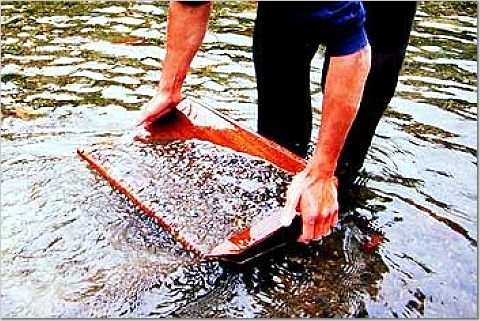
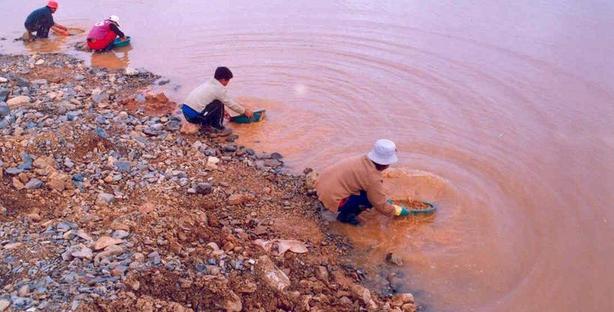
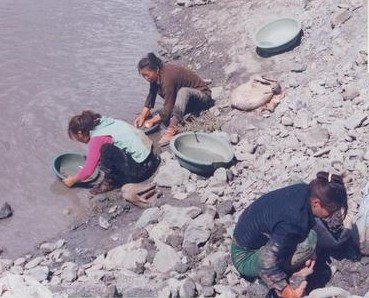
Really any moderate sized tub container can be used to wash and process gravels and extract their gold. The first 49ers of the California gold rush used spoons shaped out of shaped and molded cattle horns before they developed the "American" style gold pan. The standard gold pan we are so familiar with is a specifically American thing – and certainly not universally used. The truth is that the containers used as gold pans around the world vary quite a bit. Not every country uses something that looks even remotely like a standard USA gold pan - and even among American gold pans, there is a huge amount of variation. Many locations in South America and Asia use conical wooden bowls – these are known as a batea in the South American locations, and as a dulang in Asia, even though both are fairly similar. In Mongolia, they are using big old plastic tubs about 2 ft in diameter and about 1 ft deep - the kind of thing I would pan off into from my American style gold pan. In Japan, they use a shallow tray like object made of wood – I’m not even sure of the name. In Russia, they use a squarish wooden tray known as a lortok. So there is a large amount of variation in sizes and shapes of the things used to pan off gold bearing gravels around the world and the prospectors in each area all believe their devices are the best ones. The point of all this is that if you are scrounging around for something that can be used as a gold pan equivalent, you don't need to think about something that looks exactly like a regular American gold pan. |
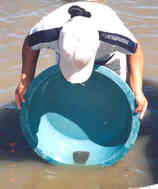 Gold Panning with a tub. |
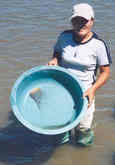 This is the biggest gold pan I've seen! |
|
|
Really, it’s the technique of how you
work your pan that’s the most important thing in recovering those valuable flakes and
gold nuggets. Panning for gold is about shaking the material and allowing
the
gold nuggets to settle downward, then washing off the lighter material - that is it
in a nutshell. Its important to be careful, but no specific
design of gold pan is sacred for doing this. That's why there are so many
different designs for pans, and yet in the hands of experienced operators,
they all work just fine to capture gold. If you would like to read my
article on how to use a gold pan, and the techniques of panning, take a look
at this web page:
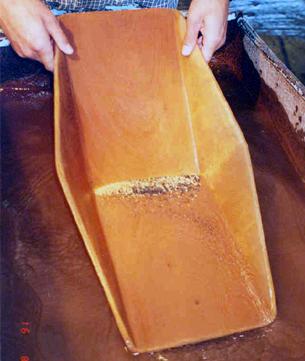
PANNING FOR GOLD So if you are ever out in the field, and see some location you would like to sample for gold with your pan, but then realize you don’t have a pan with you, think about what shallow bowl shaped containers you do have on hand which you can use to make do. Remember that lots of different things could be used as a gold pan in an emergency - and the truth is that lot of things have been used that way. Now you don’t want anything oily as that can adversely affect your gold recovery – a clean container is a must, but you don’t have to use something that looks just like the standard American gold pan to wash gravels for gold. Almost any kind of tub or plastic container will do. If you would like to see a further discussion of gold pan devices around the world, Check out the following link: World Wide Panning For Gold Here are some items used around the world for washing gold out of gravels: |
|||
|
|
 |
||
|
|
||
Want to know a little bit more about this crazy prospector guy? Well, here's a little bit more about me, and how I got into prospecting: Chris' Prospecting Story

Gold pan, Gold prospecting, panning for gold.